

Resource Roundup: 3.5 Resources from Across the Community
PKP’s Alejandra Casas Niño de Rivera brings together resources for PKP software users who are upgrading to, or using, Open Journal Systems (OJS), Open Monograph Press (OMP), and Open Preprint Systems (OPS), including version 3.5. Read on for resources from Lepidus Tecnologia, Coalition Publica, Érudit, DOAJ, TIB, CRAFT-OA, COMET, and PKP.
With the release of 3.5.0-5 and its designation as a Long Term Support (LTS) version, PKP has planned and developed documentation and education materials to support the community on all the upgrade planning, testing, and getting to know the new version tasks that come with its implementation.
However, PKP is not alone in this; other parts of the PKP Community have built resources that address that wider work. Lepidus Tecnologia maintains a plugin compatibility guide. Coalition Publica curates guides and templates for editorial practice. TIB – Leibniz Information Centre for Science and Technology and University Library has released a metadata validation plugin developed under the European CRAFT-OA project. COMET examines what happens to scholarly metadata after it leaves a journal. These four differ considerably in kind, geographical origin, and use, but share the goal of helping the community in the transition to 3.5.0-5. We have gathered them here.
Checking plugin compatibility before upgrading
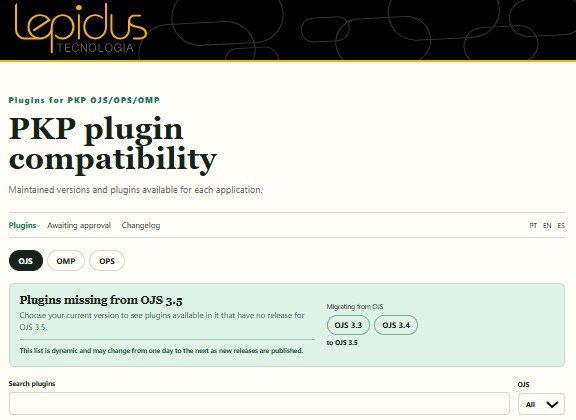
Most installations running 3.3 or 3.4 use a handful of plugins, and some support workflows that journals depend on. Until recently, establishing whether each one had a 3.5 release meant visiting repositories one by one.
The PKP plugin compatibility guide, maintained by Lepidus Tecnologia in Brazil, replaces that with a single lookup. It lists plugins for OJS, OMP, and OPS across versions 3.3, 3.4, and 3.5, including the maintainer, the latest compatible release, its release date, and a direct download link. A dedicated filter answers the upgrade question directly: choose the version the journal is running now, and the guide shows which available plugins have no 3.5 release yet.
The guide’s distinction between “not available” and “integrated into core” is worth noting. Some plugins are absent from 3.5 not because they were abandoned but because OJS absorbed what they did, ORCID being the clearest example. A second view tracks plugins with open requests for inclusion in PKP’s official plugin gallery, so you can tell whether 3.5 support is in progress rather than simply missing.
Lepidus also maintains a number of the plugins listed in the matrix. The guide draws on our official plugin gallery data, carries a timestamp showing when it last refreshed, and is available in Portuguese, English, and Spanish.
Guides and templates for editorial practice
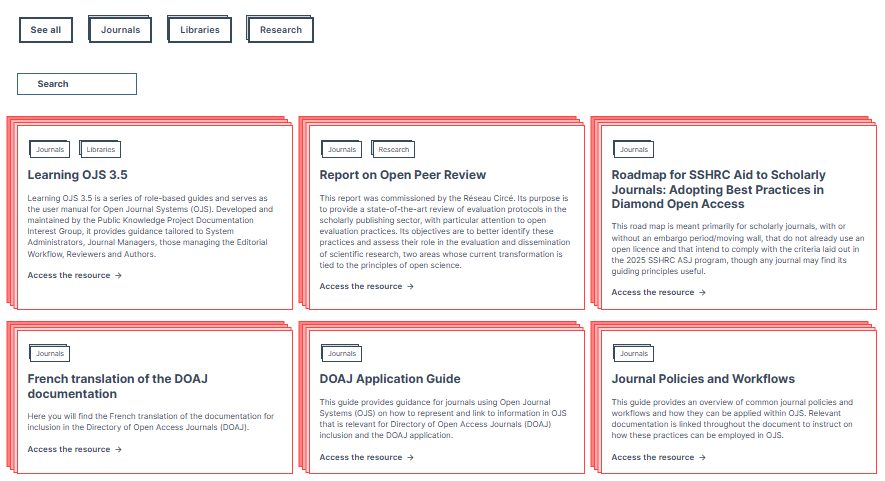
Coalition Publica’s resource collection gathers around forty guides, templates, webinar recordings, and reports in English and French, tagged by audience. Coalition Publica is the partnership between PKP and Érudit to advance open access, and the collection draws on work by both, together with the CARL Library Publishing Community Engagement Team and other community partners.
Several items address OJS directly, including the DOAJ Application Guide, Journal Policies and Workflows, Getting Found, Staying Found, and Érudit’s Preparing Quality Metadata in OJS. The most immediately reusable holdings come from University of Alberta Libraries: a journal policy toolkit for journals using OJS, a checklist of OJS settings for new journals, an example training session for editorial teams, and a set of agreement and application templates, all published openly for other programmes to adapt to their own service.
Coalition Publica is pleased to showcase materials that help build capacity for diamond open access publishing in Canada… We also highlight research that supports the development and understanding of scholarly publishing in Canada…
Contact Coalition Publica to suggest resources to add to the collection.
None of this material was written specifically for 3.5, which is the point. Questions about policy, metadata practice, accessibility, and indexing readiness persist across versions, so the guidance survives an upgrade instead of being superseded by one. It pairs well with the new OJS 3.5 courses in PKP School, which covers setup and editorial workflow in the version itself.
Validating metadata against DOAJ and OpenAIRE requirements
The Publication Validator plugin checks an article’s mandatory metadata against the DOAJ and OpenAIRE requirements before publication. Both services check the title, DOI, publisher institution, abstract, access rights, subject, and ISSN; DOAJ validation also covers licence conditions and citations, and OpenAIRE validation covers contributors. The plugin is enabled per journal, with each service selectable individually.
TIB developed it under the European CRAFT-OA project, which concluded in December 2025. The plugin supports OJS 3.5 and is distributed through GitHub rather than through the plugin gallery, with installation in the OJS generic plugins directory. This requires server-level access rather than access through the journal management interface alone.
Check out other CRAFT-OA OJS Diamond Open Access plugins.
COMET: Improving scholarly metadata beyond the journal platform
Metadata entered in OJS travels onward into indexes, aggregators, and identifier registries, where gaps and errors compound and become difficult for any single journal to correct. In many metadata systems, corrections and additions depend heavily on the original depositor, even though the wider community may hold information that could help fill those gaps.
COMET is developing a collaborative approach to metadata enrichment. The California Digital Library, DataCite, PKP, and the Centre for Science and Technology Studies at Leiden University followed a FORCE11 task force in which more than 50 organisations took part. Its pilot projects had produced enrichments for more than 6.2 million unique DOIs as of 31 December 2025, covering resource type, affiliations, and related identifiers. Those enrichments are now ingested into DataCite systems as enrichment records and can be retrieved through DataCite’s REST API, while the original DOI metadata remains unchanged.
COMET has not produced anything specific to OJS 3.5, but the two share a direction. By this release, the 3 principal persistent identifiers in scholarly metadata are handled in the core rather than by optional plugins: DOIs for the work, ORCID for the author, and ROR for the institution. Affiliations are COMET’s second-largest enrichment category, and the initiative traces its own model back to ROR. COMET’s projects are open at github.com/cometadata.

These resources come from different parts of the wider PKP and scholarly communication community. Very little of this work was coordinated centrally, and all of it is available to the whole community now.
If you know of other 3.5 resources the community has built that we have not mentioned here, please post them on the PKP Community Forum in the Community Showcase Category.