

PKP Warsaw Sprint 2026 Round-up
DOI: https://doi.org/10.59350/q7pbk-zq296
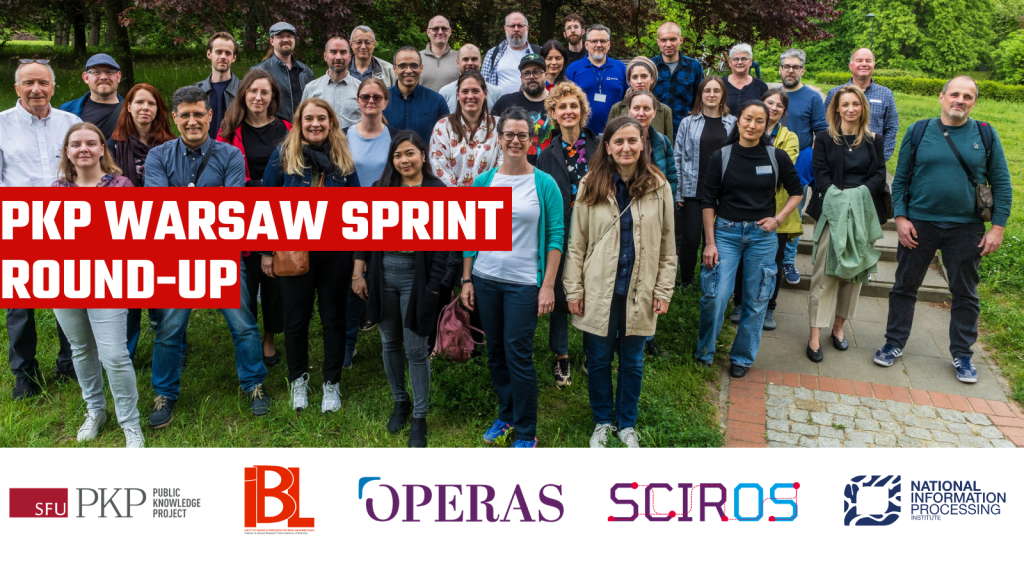
On May 18 and 19, 2026, members of the PKP community gathered in Warsaw, Poland. Journal editors, publishers, librarians, repository managers, developers, and researchers came together for two days of focused, collaborative work on Open Journal Systems (OJS) and Open Monograph Press (OMP).
PKP sprints exist to give community members a direct hand in shaping the software that supports open scholarly publishing worldwide. Rather than gathering feedback after the fact, sprints put editors, publishers, librarians, and developers in the same room to work through real problems together, over two intensive days, and to leave with something concrete: a draft guide, a filed issue, or a documented proposal.
At the Warsaw Sprint, seven Working Groups formed around topics participants identified as important: documentation for publication ethics, metadata and persistent identifiers across OJS and OMP, notification settings, workflow flexibility, review and revision processes, and the guest editor role. Each group set its own goals at the outset, then spent the two days researching, discussing, and producing outputs, whether that meant drafting new documentation, reviewing existing GitHub issues, sketching interface redesigns, or proposing new features.
The topics varied widely, but the underlying work was consistent: close, practical engagement with how OJS and OMP function today, and honest discussion of where they can improve. Several groups built directly on work from earlier sprints, including a metadata proposal first raised in Hannover, showing how sprint outcomes accumulate over time rather than starting from scratch.
These discussions matter because OJS and OMP are maintained as community software, used by thousands of journals and presses around the world with very different editorial practices, disciplinary norms, and technical capacity. Sprints are where that diversity of experience gets translated into documentation, code, and proposals that benefit the whole community, not just the participants in the room.
Working Groups
Editorial teams turn over regularly, and when they do, documentation is often what keeps a journal running smoothly. This group looked at two places where PKP’s documentation can improve: the DOAJ Export Plugin, which currently has no clear user guide, and publication ethics guidance based on COPE’s Principles of Transparency, which mostly just points editors elsewhere rather than explaining what to do inside OJS. Drawing on work already underway among Norwegian institutional publishers, the group drafted a plugin guide, compiled data-policy guidance, and proposed a structure for expanding ethics documentation across nine policy areas.
Metadata questions accumulate quickly across a software suite that serves journals with very different disciplinary needs. This group picked up a backlog of open questions about DOIs, persistent identifiers, and metadata handling in OJS, working through what was already fixed, what still needs attention, and what should be raised with partners like DataCite and Crossref. Beyond resolving individual issues, the group also practiced the mechanics of community contribution itself, searching GitHub and the forum for existing tickets and drafting well-reasoned feature proposals that others can pick up and act on.
Publishers trying to register OMP titles with platforms like DOAB often find that the metadata they need is scattered, missing, or absent entirely, particularly at the chapter level. This group traced exactly where metadata currently lives inside OMP’s editorial workflow and where it falls short, from unvalidated ISBN fields to unsupported chapter references. Their central recommendation is a single, dedicated metadata section available to editors throughout the workflow, replacing today’s scattered fields, with the OMP-Thoth plugin proposed as an interim option for publishers who need to export metadata now.
Notification settings sound like a small detail until an editor cannot tell what disabling one actually does. This group examined OJS’s notification interface, where inconsistent wording and confusing behavior have left users unsure whether they are turning off an in-app alert, an email, or both. Alongside interface confusion, the group traced real bugs, including settings that save but never take effect. Their proposed redesign separates notification and email controls into independent, consistently worded settings, backed by a draft pull request and new GitHub issues.
No two publishers run their editorial workflow the same way. Some add proofreading after layout; others skip copyediting altogether. This group explored what it would take for OJS and OMP to support that variation directly, rather than forcing every journal into the same fixed sequence of stages. Their work resulted in a concept for a journal-level setting that would allow stages to be merged, reordered, renamed, or built from templates, while keeping the Submission and Review stages fixed. Several open questions remain, but the concept gives PKP a starting point for evaluating the feature.
Authors often want to know where their submission stands, and editors often lack the tools to tell them clearly. This group looked at three connected gaps in OJS: a revisions stage with little structure or transparency, submission lists that give no indication of status, and reviewers who never respond to invitations. Their work led to a filed bug report, added support for an existing feature request on revision due dates, and a planned proposal to extend reviewer suggestions so authors and declining reviewers can recommend replacements.
This group set out to document the guest editor workflow, but the discussion shifted once it became clear how often the role has been misused, including in documented paper-mill cases tied to thousands of retractions. Guest editors hold real influence over special issues, and OJS currently gives publishers limited ability to scope or restrict that access. The group’s recommendations point in two directions: closing technical gaps, such as limiting a guest editor’s access to a specific issue, and raising awareness among journal managers about the risks before they become problems.
Cross-cutting Themes
A few themes recur through the working groups. Some of them worked on metadata and discoverability from different angles, whether that meant DOAJ export documentation, DOI handling, or OMP’s missing chapter-level fields, and all pointed toward the same underlying need: metadata that is easier to find, produce, and trust. A second theme is transparency and role clarity, visible in the work on publication ethics documentation, notification settings, and the guest editor role, all of which try to make it clearer what OJS is actually doing and who is responsible for what. A third theme is flexibility without loss of structure: the workflow stages and revision workflow groups both looked for ways to accommodate real editorial variation while keeping submissions traceable and accountable. Together, these themes reflect what scholarly publishing infrastructure needs as it matures: not just new features, but clearer, more trustworthy foundations under the features that already exist.
Looking Ahead
Each Working Group left the sprint with concrete next steps, from filing GitHub issues and forum proposals to finishing pull requests and reaching out to PKP’s design team. Some of that work is already moving; other parts will depend on further community input and PKP’s prioritization process.
PKP sprints depend on the community members who show up to do this work, and Warsaw was no exception. Details for the next PKP sprint, including location and dates, will be announced in the future. If this work speaks to you, please consider joining us.
Acknowledgements
The PKP Warsaw Sprint 2026 was organized by PKP in collaboration with the Institute of Literary Research of the Polish Academy of Sciences (IBL PAN), OPERAS-PL, SCIROS, and the National Information Processing Institute – National Research Institute (OPI PIB). Their support made it possible to bring the community together in Warsaw for two days of shared work. PKP is also grateful to DataCite, Paradigm, and Crossref for sponsoring the event, and to the individual participants and their institutions for two days of substantial, generous work.