

Undergraduate Journals can Offer Students a Long Game

PKP Founder John Willinsky tells the story of how he came to work with student journals at Stanford University, and celebrates the growth of student publishing, making a research-based case for why universities should invest in undergraduate journals.
In 2008, shortly after joining Stranford’s Graduate School of Education, I started to work with the undergraduate student journal Intersect: The Stanford Journal of Science, Technology and Society. I had been drawn to the university’s program in Science, Technology and Society (STS) by my interests in open access and open source scholarly publishing. My colleague in tech support, Wilson Wang, set up Open Journal Systems (OJS) on the school’s computing system, and before too long, Intersect’s student editors were publishing three issues a year, and I was hearing from other students interested in moving their journals to OJS or in starting new journals.
Today, there are 15 Stanford undergraduate journals (SUJ) on Stanford’s OJS installation that have published student work. Some journals are not currently publishing, and stand as an archive of earlier student work; some have been brought back to life after a period of dormancy; and some continue to publish regularly. Having now retired from Stanford, I found myself wondering about the case to be made for sustaining such a program as SUJ. After Wilson found Anthropic’s AI model Claude Fable 5.1 a great help in upgrading our OJS installation to Version 3.5, we decided to see how Claude would do in reviewing what the students had achieved and gained through SUJ.
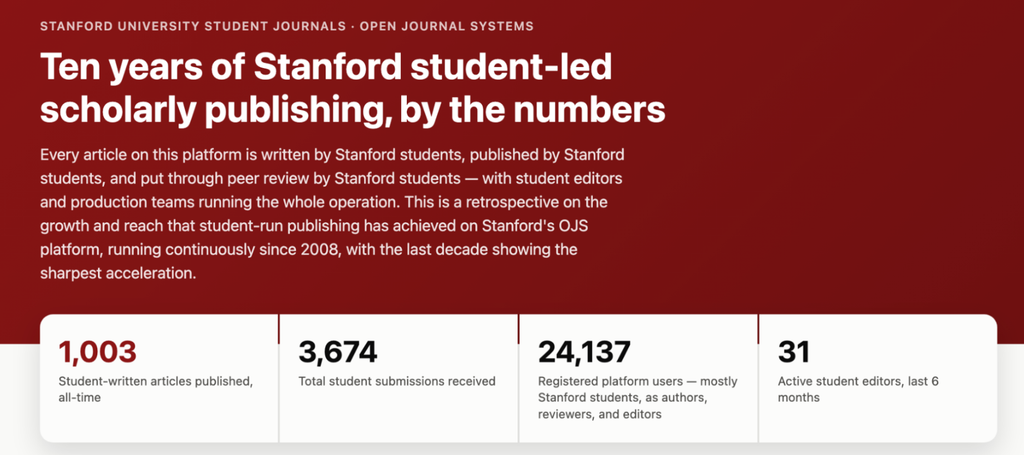
We first prompted Claude to generate a systematic set of tables and figures based on OJS’ statistical package, as well as Google Scholar, which, as Claude notes, “has no API and forbids automated access to its result pages, so the citation data were gathered by hand.” Here is the introduction to the data analysis:
Wilson and I then also took a further step by prompting Claude to prepare a report on if and how the students’ journal participation aligned with the research on writing strategies that included (drawing on my earlier experience in composition studies) “writing for real-world audiences,” “writing in the disciplines,” and “students reviewing student writing.” We were stepping into the emerging and inchoate area of AI as a research assistant, and proceeded with caution: I checked the references cited; spot checked whether recent work of note had been omitted, provide access to the resulting 5K-word report here, and, in representing Claude findings below, quote it directly. Our use of AI is consistent with PKP’s policy on accepting AI contributions to “serve the existing needs and future growth of our community.”
In reviewing 26 composition studies related to audience and reviewing, Claude noted the widespread conclusion that “students write better, and care more, when they write for someone other than the person grading them.” Claude then used SUJ data to demonstrate how almost all of the student authors did write for someone else, many times over: “The median article has 1,151 views and downloads; the mean is 2,345. More than 9 in 10 (911, or 90.8%) have over 100 events, 571 (56.9%) have over 1,000, and 37 have over 10,000. Eighty-seven articles (8.7%) show none; most are recent or are front matter.” This led Claude to surmise that “this is the first evidence I know of that student-authored articles accumulate readership and citation on the long timescales typical of professional literature, which means the value of publication extends well past the point at which any study has measured it.” On drilling further into data, Claude finds only further contrasts with typical student writing: “Half of a mature article’s readership arrives after year five; the share of articles cited triples between the first and the eleventh year.”
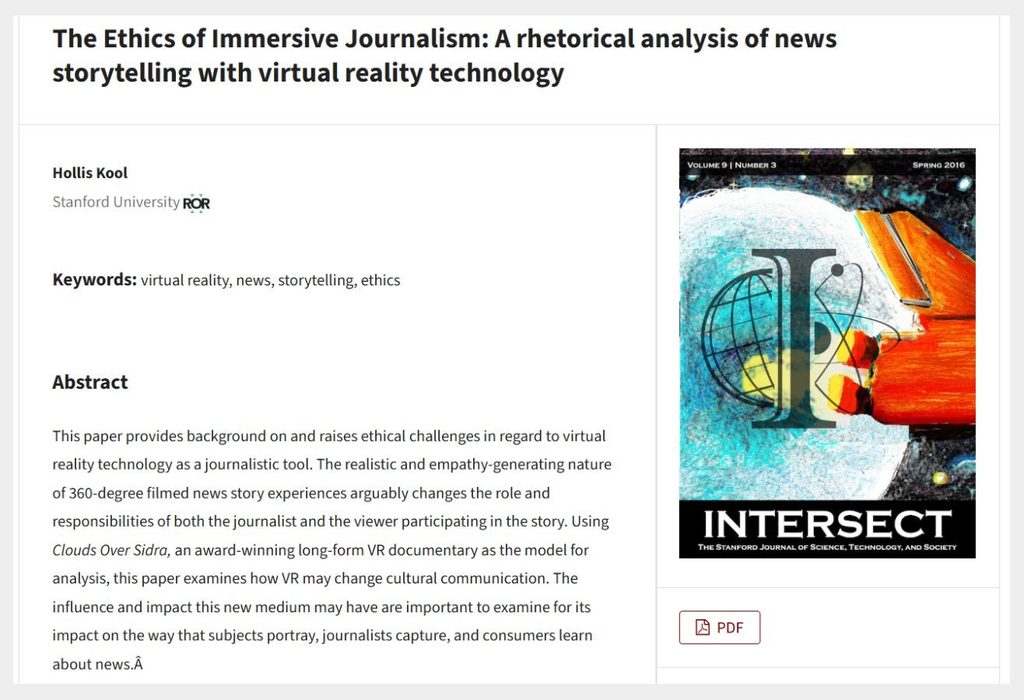
The citation data attests to how a small but encouraging portion of that readership comes from the research community: “Of the 766 articles with a verified Google Scholar record, 291 (38.0%) have at least one citation, for 1,657 citations in all [from a period of over a decade]. The most-cited is Kool’s (2016) rhetorical analysis of immersive journalism in Intersect, at 161” which was cited by articles in Cultural Studies and Cyberpsychology, Behavior, and Social Networking. Here’s a portion of Hollis Kool’s article landing page:
Only the newest of journals, launched in 2026, has no citations, given its age. As in readership, generally, an article’s citations increase with time, and going on a decade or more, again reinforcing the sense that writing for an audience remains a long-term project.
Claude also brought to our attention how only 38 of the 750 students who submitted peer reviews are also among SUJ’s 840 published authors. On seeing authors and reviewers as discrete groups, my first thought was why aren’t editors turning more often to previous authors for reviews. Yet I could also see that, given the established benefits of peer reviewing for writing (for which Claude cites three studies), the lack of overlap between authors and reviewers only extends the journal advantage to more students on campus.
Claude also helpfully points out how Wilson and I might improve our running of SUJ by noting that “OJS can show per-article usage counts on the public article page, but no SUJ journal has turned that on… the counts are not shown to readers or authors.” As a result, “the audience documented above is invisible to the students who earned it.” This does seem to needlessly reduce the pedagogical benefits of audience awareness for the students. We will be following Claude’s advice on what “the platform can already support: a 3.5-compatible plugin in PKP’s official gallery (View Counter) [that] displays per-article views and downloads on article and issue pages.” We will also be encouraging editors to include the readership data summary in their ‘About the Journal’ page, and mentioning the article counts in their acceptance emails to authors, as well as suggesting a Google Scholar or OpenAlex check in a few years for citations.
Finally, in an interesting twist, Claude notes that while machines are increasingly “readers” of SUJ — as AI-agents are able to circumvent OJS’ bot filtering — there is still a human reader, if at the end of the loop:
If a growing part of the audience that “arrives” is a language model fetching a student’s article to answer someone else’s question, then what counts as a real audience, and whether being read by a machine that then speaks to a human satisfies the motivational and evaluative functions the literature gives to audience, becomes a live question. I raise it here rather than answer it.
Claude wisely leaves its “live” question unanswered, as so much of the AI effect has the quality of being indeterminate at this point.
This is, then, one version of the case for university sponsorship of undergraduate journals. The number of students involved on campus may be relatively limited, but no more so than for the university’s football team (Claude did not work out the student overlap in this case). These Stanford students’ experience, reach, and impact, in undertaking this extra-curricular activity in their spare time, needs to be recognized and made clear to them, for its educational benefits and in creating value for others.
For those involved in undergrad journal programs more widely, it should be reassuring to learn the scale and persistence of readership; the degree to which the students’ studies can be cited by the professional literature; and, perhaps most importantly for an educational institution, the ways in which student involvement aligns with the research on improving student writing. Our hope is that this report will lend support to those working on and with undergraduate journals, while serving as an inspiration to those considering such a project. There is much to celebrate in this work, excellent examples of which can be witnessed each year at both Canada’s Student Journal Forum and the American Student Journal Symposium for Literary and Research Publications.
Acknowledgement: For nearly two decades, Wilson Wang has been a brilliant and tireless collaborator in supporting SUJ, for which I remain grateful.