

58,000 Journals and Counting: The 2025 OJS Beacon Data
DOI: https://doi.org/10.59350/1v51v-e0831
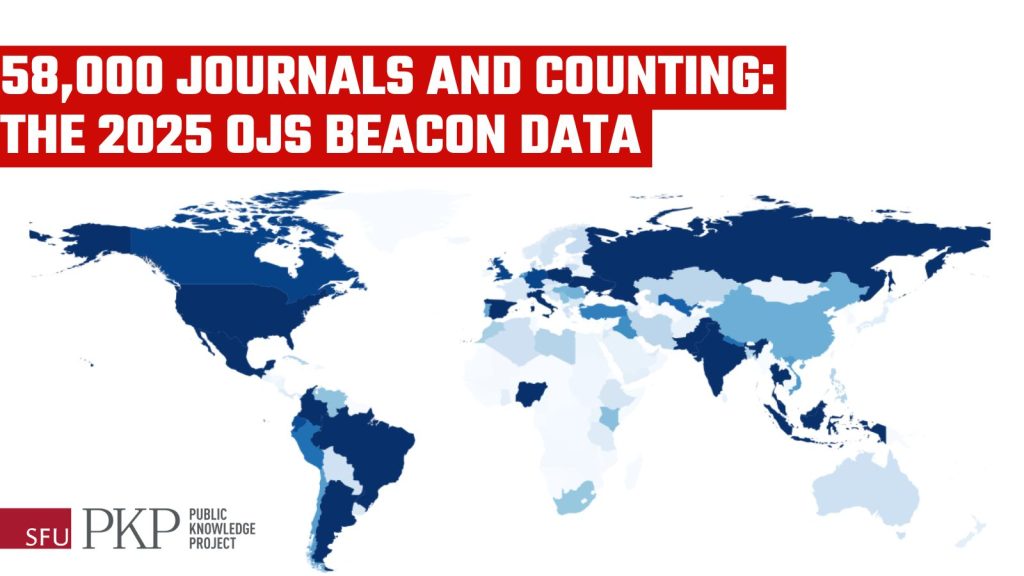
The 2025 Beacon dataset is out. It shows OJS powering 58,000 journals across 156 countries, with 2.5 million articles published and steady growth in software upgrades. Here’s what the data tells us.
Open Journal Systems (OJS) launched in 2002. By 2010, around 4,000 journals were using it. What followed was more than a decade of steady growth, typically between 5,000 and 7,000 new journals per year. That growth has now levelled off, and we think that deserves to be read for what it is: a sign of maturity, not of stagnation.
The 2025 figures stand at 58,000 journals across 156 countries. That is the footprint of infrastructure.
For librarians and open access advocates who have spent years making the case for community-owned publishing platforms, this scale carries real weight. For tens of thousands of journals, many of them Diamond Open Access charging neither authors nor readers, OJS is how publishing gets done.
Where the Journals Are
Geography has always been one of the most revealing dimensions of the Beacon data, and this year is no different.
Indonesia continues to lead the world by a wide margin, accounting for more than 40% of all OJS journals globally. That position reflects both a sustained national commitment to open access policy and a publishing culture that has embraced open infrastructure at scale.
Brazil retains its place among the top countries, underpinned by a long tradition of publicly funded, openly accessible research communication.
And in a development worth noting, the United States has recently moved into the top three, as more North American institutions look seriously at open infrastructure as a sustainable path forward.
Understanding where open publishing is growing, and where it has not yet been adopted, is one of the main reasons PKP collects this data in the first place. It directly shapes decisions about language support, documentation, outreach, and development priorities. The geography of OJS adoption is not just interesting; it is useful.
Articles: The Numbers Behind the Journals
The Beacon data tracks article output per journal over time. The average number of articles per journal peaked at 62 in 2015, fell to 30 in 2022, and has since recovered to just over 40. Across all OJS journals, total article output now stands at 2.5 million articles.
These figures matter beyond the headline numbers. They represent peer-reviewed research that, in many cases, would not be openly available without community-owned infrastructure. A significant portion of it comes from institutions and regions with no viable route into commercial open access. That research belongs to the communities that produced it, and it is accessible because of the infrastructure those communities chose to use.
A Meaningful Milestone: Version Upgrades
Since 2024, there has been a 10% increase in journals upgrading to OJS version 3.3, with more than 4,000 journals completing the transition. Software upgrades take real effort: technical capacity, planning time, and often institutional backing. The fact that so many journals have made this move reflects the work PKP has put into making upgrades accessible, through sprint events, hosting support, education, and documentation.
This data connects directly to PKP’s focus on supporting the health and sustainability of journals already using OJS, not just reaching new ones.
Why PKP Collects this Data
PKP collects this data to inform its own decisions: where to focus development, where documentation is needed, where the software is being used in ways that point to unmet needs. The dataset is published openly on Harvard Dataverse so that researchers, institutions, and partners can draw their own conclusions from it. The global OJS community is not the subject of this research. It is the reason for it, and its primary beneficiary.
That approach is central to how PKP works. Research informs what we build and how we prioritize. The Beacon project is one of the clearest expressions of that commitment.
Explore the Data
- 2025 OJS Usage Statistics — interactive charts and maps (2025 data)
- Full Beacon dataset on Harvard Dataverse (2024 data)
If you are a journal manager, a librarian building the case for open infrastructure, or a researcher working on scholarly communications, this data is freely available for you to use.
The Beacon project is a longitudinal research initiative tracking the global adoption and use of Open Journal Systems. Data is collected annually and published openly under Creative Commons licensing.