

Exploring what it means for the Public Knowledge Project to be driven by research with Juan Pablo Alperin
DOI: https://doi.org/10.59350/pe618-tnd23
In this interview, PKP’s Scientific Director, Juan Pablo Alperin, discusses the meaning behind PKP as a project, what research has to do with it, and how PKP research drives its values, vision, and mission.
The value of scholarly inquiry and the contribution of research to the public good are being questioned more frequently and with greater intensity. This makes it all the more crucial to pause and reflect: how does scholarly inquiry inform and guide the work we do? In building robust, free, and open-source infrastructures for scholarly communication, we are doing more than supporting research; we are shaping a system that keeps knowledge accessible and diverse for the benefit of all. That’s why, to start this year, we’re featuring an interview with PKP’s Scientific Director, Juan Pablo Alperin, on why research matters in building these infrastructures.
The word “project” in Public Knowledge Project might seem like a small detail, but it was chosen intentionally. Can you speak to why that word matters, and how it reflects PKP’s identity as both a research initiative and a long-term commitment to building open infrastructure?
The “Project” of Public Knowledge Project has two meanings for me: the first characterizes our academic identity and the usual way in which research initiatives like PKP are typically organized into a project with a team, working towards common goals, and creating outputs along the way; the second characterizes our mission towards a broader societal project of ensuring that everything that we know become known.
PKP is often described not just as believing in open, but as building it. What’s the driving force behind that commitment? From your perspective as a researcher, what does the evidence tell us about why open access matters?
I’ll take the second part first. We have evidence that people really do use Open Access resources — and not just researchers! I always try to remember a phrase used by PKP’s Founder, John Willinsky: Open Access is Public Access. When we make things available, the public — all sorts not affiliated with any academic institution — make use of the work. Whether to support them in their work, to help others, or simply to satisfy their curiosity, scholarly works are used in many unexpected ways.
Our dedication to ‘building’ open grows from the same Open Science principles that fuel our support for open access. We believe that researchers shouldn’t simply present their work to the world, but actively invite others — including the public — to take part in it. In the same way, our mission extends beyond analyzing scholarly communication from a distance. We aim to be fully engaged in shaping it, contributing to a more connected, participatory ecosystem.
How does PKP’s research orientation shape its software development process, particularly for supporting diamond open access? Can you share examples of decisions or features that have been directly informed by research findings?
Our research into scholarly communication shapes the software in both broad and specific ways. Broadly, our long-standing focus and orientation towards scholar-led publishing from around the world has an empirical basis that has always gone counter to large commercial publishers served by other manuscript management platforms. This translates into specific features, such as the most complete implementation of multilingualism in the software (for interfaces, metadata, and content).
To draw on a more specific and recent example, the development of the Publication Fact Label has been entirely research-driven. The need for something like the label was born out of a growing literature on predatory publishing and our desire to see a positive response that could help us move away from that pejorative term, the use of lists of approved and banned journals. An initial design for the label was tested through surveys and focus groups with various communities, and eventually refined into the plugin that was just released with OJS 3.5.
As Scientific Director, how do you help align PKP’s research priorities with its broader goals, like supporting quality, diverse, diamond open access publishing?
When evidence to guide the community is lacking, I see it as my responsibility to generate it. In practice, this means identifying issues that directly affect PKP’s mission — especially those that shape the quality, equity, and sustainability of diamond open access publishing — and designing research that can address them. For example, much of my current work focuses on metadata quality, because strong metadata underpins both discoverability and trustworthy assessment. By investigating the specific challenges faced by smaller, resource-constrained journals around the world — including many that depend on OJS — we can surface structural barriers that limit their visibility and impact.
The ability to aggregate and analyze metadata across the wide diversity of OJS journals now gives us, for the first time, a global evidence base. This bibliometric research not only helps us understand the real conditions of diamond OA publishing but also informs PKP’s development priorities, standards work, and community guidance, ultimately supporting the fuller inclusion of these journals in the scholarly record.
Beyond code and feature releases, PKP’s work is grounded in research with a broader social mission. As a research project, how do you see PKP contributing to a more just system of knowledge creation and access? What kind of research impact do you hope PKP is having, not just on publishing, but on society more broadly?
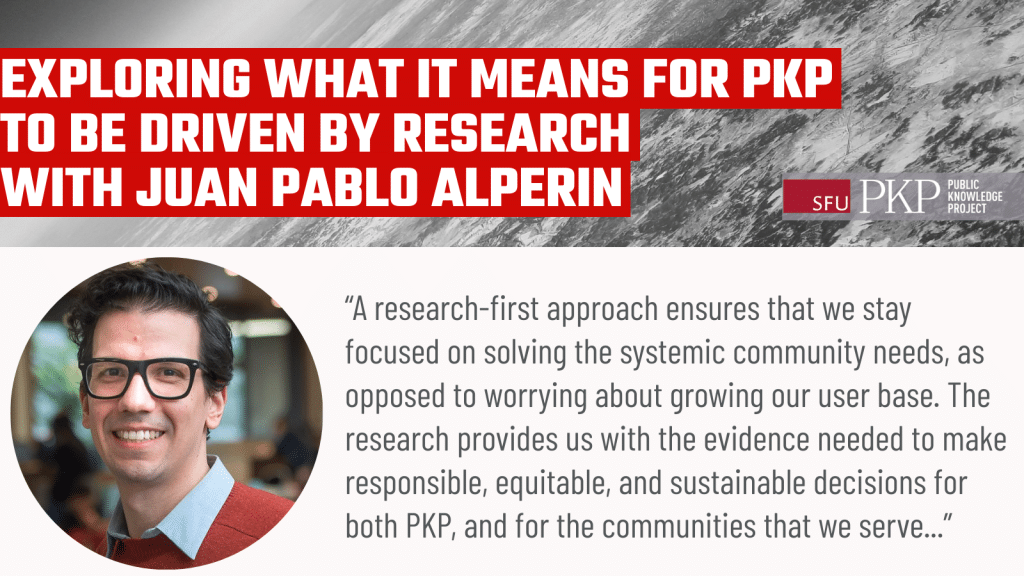
A research-first approach ensures that we stay focused on solving the systemic community needs, as opposed to worrying about growing our user base. The research provides us with the evidence needed to make responsible, equitable, and sustainable decisions for both PKP and for the communities that we serve, which are often invisible in data. What’s sometimes missed is that this work requires time to collect and interpret data, challenge assumptions, and translate findings into meaningful priorities. The outputs may be less immediate and often intangible, but the insights gained from this work are what make our software development aligned with real community needs and give us legitimacy when advocating on behalf of the users of our software.
Thank you, Juan, for taking the time to highlight that PKP is at its core a research initiative, founded by a scholar, housed within a university, and guided by a Scientific Director, and why that matters for building open and sustaining scholarly infrastructures.
Jump to other features in this issue of Archipelago, PKP’s Community Newsletter
- Development Dispatch — Feature Highlight: Manage and Track Editorial Tasks in OJS 3.6 with Magnus Lu
- Community News — What’s Coming to PKP Education and Programming in 2026
- Community News — Relawan Jurnal Indonesia Celebrates 9th Anniversary with Symposium and Training Program
- Collaboration Corner
- Past Events — A Year in Review: PKP’s 2025 Event Recap
These are just the feature segments. If you subscribe to our newsletter emailed about every 2 months, you will also learn about resource roundups, upcoming events and more.
Happy reading!