Open Monograph Press
[For latest documents guiding the development of OMP, scroll to the bottom of page.]
For current information and projected release dates, view the OMP Roadmap
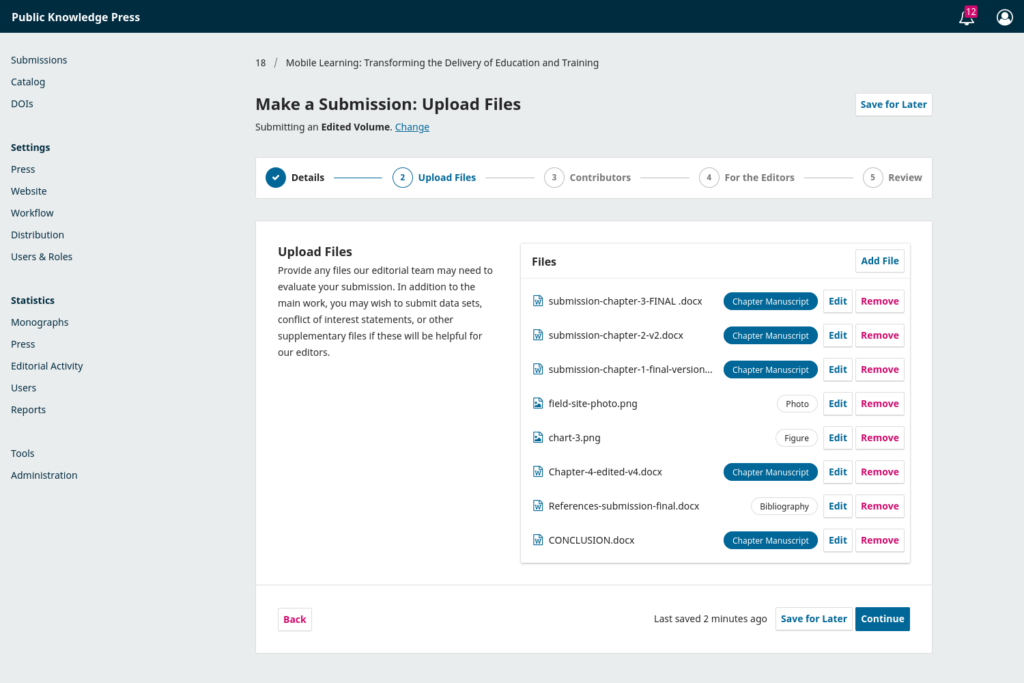
Open Monograph Press, a new open source publishing product under development by the Public Knowledge Project, will establish an online workspace for publishing monographs, edited volumes, and scholarly editions, while keeping an archival record of the process (compatible with the Fedora repository).
OMP will be based upon the modularization of the existing PKP software, where separate modules (submission module, review module, etc.) will be re-assembled and customized to create this new system.
The modularization of components enables the Press to plug and play (drag and drop) pieces into place that would best match the editorial process. Here is an example of the modules that would go into the Assessment, Publishing, and Production processes, creating a manuscript workflow based on the publishing process used by the Athabasca University Press, one of the partners working on this system with the Public Knowledge Project:

The plans for OMP also include the potential for users to set up a Social Networking Incubator and Workspace system that would enable editors to create a workspace for authors who have a potential monograph project in hand to develop ideas within an invited or more open community, before moving into a formal book proposal and submission process.

This will provide author and editor with a series of tools and spaces that would allow them to see if there is a book residing within an article-length work, by bringing together authors and select communities of interest - or potentially anyone interested, at the author and editor’s discretion (Access Scheduler) - for engagement and response.
On coming across a promising series of articles or major research project, an editor from the Press would invite potential book authors to initially set up a page with an author blog or link to an existing blog, as well as resources for posting related articles, working papers, source materials, reference list, etc. The editor and author decide who has access to what parts by setting up password-protected communities of interest in advance or by tagging materials and opening them to those interested, and seeing where the promise for the potential book is to be found.
The editor is able to annotate materials, as well as add to blog for author/public, and decide, at some point, to advance the work to a full submission to the Press, continue the incubation, or terminate the project. Authors are able to tag work as part of a scholarly network associated with the Press for alerting interested readers. Authors are also able to use composing tools such as CommentPress, wiki and Google Docs (for multiple authors), and scholarly electronic edition software (TEI-XML), etc. At some point, editors and authors would decide to submit a complete draft to the press for formal evaluation and possible publication, or to cease the search for the book-length project.
OMP will also include a Publication Site where the author can include links to incubation materials ( e.g., multimedia productions) and to 2-way links (e.g., archive and publication).
Roles associated with the system may include the following:
SERIES/ACQUISITIONS EDITOR
- The Series Editor and/or Acquisitions Editor runs their own blog on Press site as expression of interest for authors.
- Invites potential authors to initially set up studio page with author blog, etc. for posting work.
- Able to annotate materials, as well as add to blog for author/public.
- Decides when to advance, continue, or terminate projects.
- Uses the editorial workflow, supported with templates, user-lists, emails, etc.
- Can invite reviews in Submission and Review stages, along with Sources, Data etc.
PRODUCTION EDITOR
- A Production Editor oversees editing, illustration preparation, automated XML conversion, page design, and proofing. The Production Editor would also implement page, file, and book design elements.
MARKETING MANAGER
- The Marketing Manager runs Marketing and Cataloguing, supporting the Publication Site and its post-production.
- Consults on design and publication formats for integrating materials (print, TEI-XML, PDF, DVD, MP3. etc.).
- Implements applicable economic models for books (including open access), purchase, subscription, pay-per-view.
- Uses PExOD to gather and export ONIX metadata and promotional info for Press catalog, libraries, Amazon, etc. prior to and after publication.
- Monitors time and cost factors for titles, as well as associated usage.
REVIEWERS
- Invited reviewers can enter comments, review forms, annotations, uploads - exclusive to editor or not.
- Able to use Reading Tools and, if permitted, incubation materials.
- Able to control access to reviews and able to augment reviews or add Commentary after publication.
READERS
- Readers are able to discover the site through Google or sign up for (RSS) notification for any stage or part based on interests.
- Able to use Reading Tools with all materials made available during the process.
- Able to post responses, mash-ups, links, etc., with Press approval.
- Able to create their own private or public annotated libraries and collections.
Exhibitions and Archives, with Catalogue and Monograph Capacities
While the actual figure for this concept has not been worked out, it does serve to promote the idea of extensible modularization.
The idea is that a group of scholars in the humanities, with an interest in a scholarly project focused on archive-able materials (medieval manuscripts, musical scores and performances, an author’s letters, etc.), would be able to use the different OMP modules to assemble a work, including the social networking incubator working space, the Submission module for assembling the component parts of the work, the Production module for developing the components, the Sign-off modules for assessing the materials to be archived, ensuring that they are of exhibition quality, in terms of reproductive quality and image resolution, as well as full documentation, identification, provenance, and permissions.
In addition, catalogue materials for the artifacts would be treated as texts that would be submitted and pass through review and revision, copyediting and layout; these catalogue materials would subsequently be hyperlinked to the relevant artifacts.
The catalogue could continue to grow, as well as start anew, with a second or third catalogue created from a different perspective on the archive.
The Aggregator module could be used to link up related collections that exist on other websites, serving as a portal to collections on a given theme, and allowing them to be viewed separately or integrated by catalogue into the current archive and exhibition.
Catalogued artifacts could be published as a collection, with options to view the artifacts with or without accompanying catalogue information. The collection can be made available to classes of students, who could work on their own cataloguing of some portion of the work, although that catalogue may be exported and made public in association with the school, rather than the scholarly project or institution operating the system. Extended catalogue commentaries could be regarded as monographs, and be published as such. Special exhibitions of the originals could be accompanied by digital cataloguing and commentary.
Monograph Funding
The development of something approaching an “economic model” for open monograph publishing will inevitably entail a combination of approaches that build on how work has always been supported in the humanities, involving small grants, the cooperation of libraries and archives, and the active collaboration of scholars and graduate students.
The key to this approach is to be able to offer scholars and authors a series of economic-model options which they can pursue from the outset (based on relatively accurate projected costs). Read more....
An earlier outline of the OMP project is available here.
We also provide a free, online support forum where you can post any questions that you may have regarding OMP: http://pkp.sfu.ca/support/forum/
If you are interested in finding out more about the Open Monograph Press, or getting involved at this early stage of development, please let us know.
| Attachment | Size |
|---|---|
| Monograph Funding.doc | 33 KB |
| Monograph Article.doc | 199 KB |
| Monograph and Edited Volume.doc | 48 KB |