The post Where’s the Data? Finding It, Moving It, and Loving It through PKP Interoperability appeared first on Public Knowledge Project.
]]>
February 9 – 13 2026 is International Love Data Week, but PKP celebrates data sharing all year round. Considering the theme “Where’s the Data” in this post, the answer at PKP is clear — the data is everywhere and interoperability is how we help it flow.
International Love Data Week is a moment to celebrate not just data itself, but the systems, people, and partnerships that make data visible, usable, and meaningful. This year’s theme — Where’s the data? — asks an important question for open scholarly publishing. At PKP, the answer is clear: the data is everywhere, and interoperability is how we help it flow.
In scholarly publishing, data is rarely static or siloed. It lives in submission systems, editorial workflows, indexing services, preservation networks, metrics platforms, repositories, and discovery tools. For journals and presses using PKP software, the challenge isn’t whether data exists — it’s how to connect it across systems in ways that are sustainable, transparent, and community-governed.
That’s where PKP’s approach to interoperability comes in.
Rather than building a closed ecosystem, PKP software is designed to work with a wide range of partners across the scholarly communications landscape. The PKP Plugin Gallery is a concrete expression of that philosophy: a growing collection of integrations that help answer the question “Where’s the data?” at every stage of the publishing lifecycle.
Plugins and core feature enhancements aren’t just technical add-ons. They’re acts of stewardship for data, ensuring it can be:
These are only some of the ways that the PKP software suite is interoperable, sharing data with other infrastructures. More examples include plugins like COinS for grabbing citations, COUNTER Reports for generating journal activity data, Dataverse for allowing authors to submit associated research data with manuscripts, Funding for adding submission funding data using the Crossref funders registry, Publication Facts Label for putting spread out journal information in one place, OpenAIRE for improved data sharing, and much more.
From metadata deposits to preservation workflows, PKP plugins help data move where it needs to go, without requiring reinvention of infrastructure.
Many of the tools in the PKP Plugin Gallery exist because of partnerships with organizations that share PKP’s commitment to open, community-led infrastructure. These integrations reflect a collective understanding that no single system can or should do everything.
Each plugin represents a bridge between editorial work and discovery, between local publishing contexts and global research networks, between today’s publishing needs and tomorrow’s preservation requirements. Together, they help ensure that data generated through PKP-powered journals doesn’t disappear into the void, but instead remains findable and reusable.
For example, in an Archipelago interview, PKP’s Scientific Director Juan Pablo Alperin had this to say about the importance of mobilizing metadata, how collecting and analyzing the data contributes to research, and ultimately impacts the scholarly record.
The ability to aggregate and analyze metadata across the wide diversity of OJS journals now gives us, for the first time, a global evidence base. This bibliometric research not only helps us understand the real conditions of diamond OA publishing but also informs PKP’s development priorities, standards work, and community guidance, ultimately supporting the fuller inclusion of these journals in the scholarly record. — Juan Pablo Alperin
Love Data Week invites us to ask hard questions about data: who controls it, who can access it, and who benefits from it. In scholarly publishing, those questions are inseparable from infrastructure choices.
By supporting interoperability through open plugins and partner integrations, PKP helps journals, presses, and preprint servers retain agency over their data while still participating fully in the broader scholarly ecosystem. The data stays with the community but it doesn’t stay stuck.
This Love Data Week, we’re celebrating not only data itself, but the often-invisible work that allows it to circulate: open standards, shared governance, thoughtful partnerships, and interoperable tools.
So, where’s the data?
In PKP software, it’s in the connections: moving between systems, enriched by partners, preserved for the future, and always rooted in the communities that create it.
Happy Love Data Week 

International Love Data Week is organized by the Inter-university Consortium for Political and Social Research (ICPSR), an international consortium of 800+ academic and research bodies.
Use the hashtag #LoveData26 to share this post and your love for data sharing!
The post Where’s the Data? Finding It, Moving It, and Loving It through PKP Interoperability appeared first on Public Knowledge Project.
]]>The post PKP Welcomes Teresa Lee as new Managing Director appeared first on Public Knowledge Project.
]]>

The Public Knowledge Project is pleased to announce the appointment of Teresa Lee as its new Managing Director, effective February 2nd, 2026. Teresa will guide PKP into its next chapter while continuing the solid foundation established by the community, partners, and team members who make PKP’s work possible.
Teresa is a librarian and publisher with experience in Canadian academic libraries, the US government sector, and UN publishing. She held roles as the Associate Dean, Research and Open Scholarship at York University Libraries; Knowledge Manager at the International Agency for Research on Cancer (IARC), the cancer research arm of the World Health Organization (WHO); E-resource and Access Librarian at UBC; and Liaison Librarian to UBC’s Faculty of Pharmaceutical Sciences. Teresa is a graduate of UBC’s iSchool, and was an Associate Fellow at the US National Library of Medicine. She brings a well-rounded perspective that is informed by experience and ongoing professional interest in health librarianship, e-resources, licensing, copyright, intergovernmental publishing, bibliometrics, and scholarly communications. She is committed to equity in the making and sharing of knowledge.
This experience aligns closely with PKP’s commitment to conduct research, develop free and open source software (FOSS), and work to increase the quality, diversity, and accessibility of scholarly publishing.
PKP remains firmly committed to its mission, values, and community-driven approach, and will continue to maintain its commitments to build a Diamond Open Access future, champion open source citizenship, drive continuous improvement with mindful innovation, and strengthen organizational culture with Teresa’s knowledge and experience.
The transition in leadership represents honouring the work that has brought PKP to where it is today, while confidently preparing for the future.
We invite our community, partners, and stakeholders to join us in welcoming Teresa to PKP. Together, we look forward to advancing our shared goals and strengthening the impact of PKP’s work worldwide.
The post PKP Welcomes Teresa Lee as new Managing Director appeared first on Public Knowledge Project.
]]>The post A Year in Review: PKP’s 2025 event recap appeared first on Public Knowledge Project.
]]>
Throughout 2025, PKP and our partners continued to connect with communities around the world through workshops, conferences, webinars, and in-person gatherings. From student-led publishing initiatives in Canada to global conversations on open infrastructure, multilingualism, and equitable publishing, this year offered many opportunities to share knowledge, build relationships, and reflect on the future of scholarly communication.
DOI: https://doi.org/10.59350/qz73c-zyf80
Below is a recap of PKP-related events from across 2025 and a look at the ideas, conversations, and collaborations that shaped the year.
February 18–20, 2025
The annual Canada Student Journal Forum was jointly hosted by 12 institutions and organizations across Canada and sponsored by the University of Toronto Libraries, PKP, and Coalition Publica.
The event brought together student journal teams from across the country and featured:
Participants explored the realities of student-led publishing while building connections within a supportive national community.
Learn more and explore recordings and slides from each scheduled day.
March 11–12, 2025
Partners from PKP and Érudit met in person to deepen collaboration within Coalition Publica. The meeting focused on strategic planning, shared goals, and feedback on ongoing projects supporting scholarly publishing infrastructure in Canada.
As Coalition Publica continues to evolve, this gathering helped align priorities and strengthen relationships that underpin long-term sustainability.
April 16, 2025
Coalition Publica presented a new open dataset documenting historic and active Canadian scholarly journals, offering an unprecedented overview of the national publishing landscape.
In this one-hour webinar, participants learned about:
May 20, 2025
This webinar highlighted the PKP Preservation Network (PKP PN) — a free, open-source digital preservation service for journals using OJS.
Featuring Mark Jordan (Simon Fraser University) and Mariya Maistrovskaya (PKP), the session explored how journals can safeguard long-term access to scholarly content with minimal effort.
June 2–3, 2025 | Oslo, Norway
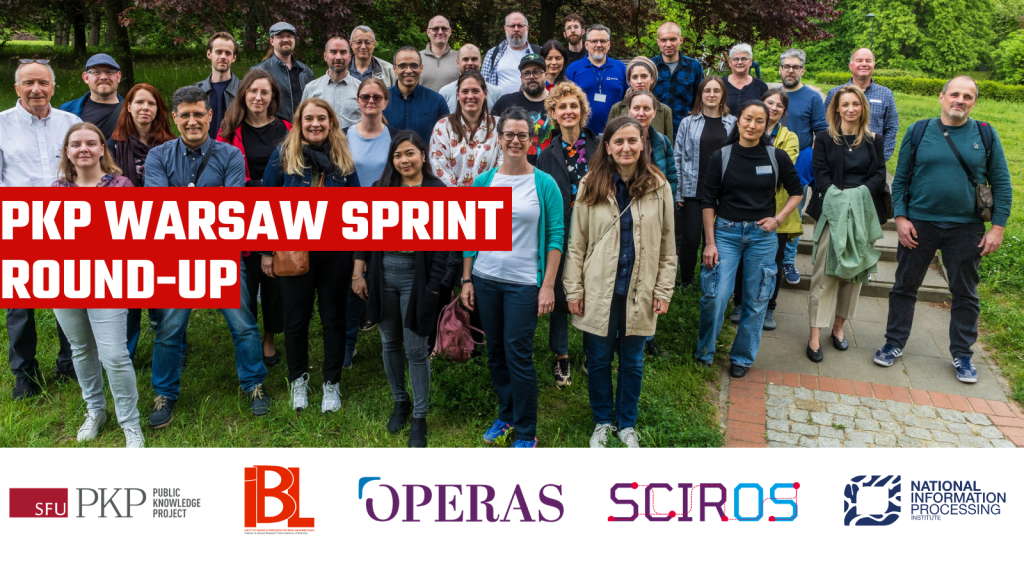
Over 45 community members and PKP staff from 15 countries gathered at the University of Oslo for the PKP Oslo Sprint.
Sprint topics included submission workflows, dissemination for open books, and multilingualism. Participants collaborated on enhancements, shared ideas, and built lasting connections across regions and roles.
June 16, 2025
This webinar provided updates on features available in OJS / OMP / OPS 3.5 and a preview of what’s coming in version 3.6, including:
June 17, 2025
PKP’s AGM offered a moment to reflect on the previous fiscal year and look ahead to the organization’s next chapter in open access leadership.
Highlights included:
Download the 2024 Annual Report
Watch the AGM recording
August 18–22, 2025 | Astana, Kazakhstan
PKP’s Scholarly Publishing Advisor Mariya Maistrovskaya presented “It Takes a Village: How Library Contributions to Open Infrastructure Shape Global Open Science” at the 89th IFLA Congress.
The presentation highlighted the essential role libraries play in sustaining open platforms and collaborative infrastructures worldwide.
September 15, 2025
Part of PKP’s quarterly series, this webinar shared in-progress development insights across OJS, OMP, and OPS. These sessions support Strategic and Development Partners, contributors, and the broader community in staying aligned with platform evolution.
September 15–17, 2025 | Geneva, Switzerland
PKP Scientific Director Juan Pablo Alperin participated in the panel “Open Research Europe: A Catalyst towards Equitable Publishing”, discussing how ORE supports more equitable publishing models across Europe.
September 16–17, 2025
At NISO Plus, PKP founder John Willinsky and colleagues presented on the Publishing Facts Label (PFL) — a proposed community standard for transparent journal-level information.
The session explored pathways for PFL adoption as an industry standard supporting trust and clarity in scholarly publishing.
September 22–24, 2025 | Belgium
PKP participated in the panel “Scaling Inclusive Open Access Models”, contributing to conversations on sustainability, partnerships, and equity in open access publishing.
September–October 2025 | Ecuador
PKP participated in two events in Ecuador:
October 1, 2025
PKP’s Mike Nason presented a DataCite-hosted webinar focused on optimizing DOI metadata and discoverability using OJS.
October 9–10, 2025 | Montreal, Canada
At this conference:
October 30, 2025
PKP and SFU introduced a new collection of online courses developed with SFU’s Master of Publishing (MPub) program. The webinar offered a behind-the-scenes look at course content designed to support practitioners navigating today’s scholarly communications landscape.
Watch the recording
Learn more about the courses
Thank you to everyone who joined us throughout 2025, whether in person or online, for contributing ideas, expertise, and energy to these conversations.
Stay tuned to PKP’s social media, news blog, and Community Forum for upcoming events and opportunities to connect in 2026.
These are just the feature segments. If you subscribe to our newsletter emailed about every 2 months, you will also learn about resource roundups, upcoming events and more.
Happy reading!
The post A Year in Review: PKP’s 2025 event recap appeared first on Public Knowledge Project.
]]>The post Feature highlights: Manage and track editorial tasks in OJS 3.6 appeared first on Public Knowledge Project.
]]>
Create checklists, assign tasks, monitor deadlines, and more, all without leaving OJS.
DOI: https://doi.org/10.59350/4mmn7-q0y83
This article focuses on three features built into the upcoming OJS 3.6 release, planned for Fall 2026, that help journal managers and editors collaborate with colleagues and keep track of tasks from start to finish.
In OJS 3.5 and earlier, task lists, due dates, and assignments during the various stages — submission, review, copy-editing, and production — are typically managed via spreadsheets and emails outside of OJS.
OJS 3.6 allows you to perform these functions without diverting your attention elsewhere.
Here’s how it works.
Open the submission.
Tasks and discussions are contained within a submission, since only users who can view and contribute to a submission can see and participate.
Create a series of tasks to form your to-do list.
As a journal manager or editor, you can create a series of tasks that comprise a to-do checklist.
Here is what the task creation screen looks like:

The key components of a task are the task details, the assignee or person responsible, the participants who are involved in the submission, and the due date.
Overview of tasks in OJS 3.6:
An example of a common use case is Open Research Europe’s pre-publication criteria, a list of requirements that need to be met prior to a submission being published on the site.
A Pre-publication Manager is responsible for ensuring these requirements are met, but the process may involve communication with the author and possibly delegating tasks to others.
During the process, the Pre-publication Manager can use the stage-specific dashboard, as shown below, to retrieve an at-a-glance status of what needs to be done, when, and by whom.

Using the discussions functionality, you can create a message or use a predefined message, attach files, and select from a list of participants. This functionality also exists in OJS 3.5.
With the introduction of tasks to OJS 3.6, discussions can be added within a task, ensuring discussion topics are focused and visible to only relevant users.

Creating task templates for reuse and scheduling
Use a template to save frequently-used tasks and schedule them to appear at the right stage. This handy feature lets you easily create and reuse a series of tasks or checklists rather than recreating them from scratch every time.

OJS 3.6 provides enhanced functionality with a user-tested and intuitive UI that avoids settings and configuration complications by letting you make on-the-spot decisions in the workflow.
To see a walkthrough of these features and more, please join us on January 28th, 2026, at 09:00 PT for a working demo of tasks and discussions hosted by lead developer, Vitaliy Bezsheiko. Sign up now!
These are just the feature segments. If you subscribe to our newsletter emailed about every 2 months, you will also learn about resource roundups, upcoming events and more.
Happy reading!
The post Feature highlights: Manage and track editorial tasks in OJS 3.6 appeared first on Public Knowledge Project.
]]>The post PKP welcomes three new members in 2026 appeared first on Public Knowledge Project.
]]>
PKP thanks Sikt, OJS Deutschland, and the Max Planck Digital Library for supporting open, community-governed scholarly publishing infrastructure.
DOI: https://doi.org/10.59350/86wnr-hst84
The Public Knowledge Project starts 2026 by welcoming three important members to the growing number of contributors that support its operations. PKP relies on its community of contributors to strengthen and grow its ongoing maintenance and development. Financial and in-kind contributions from members enhance and direct software development, educational initiatives, and research programs. Today, we are proud to recognize several recent contributions that exemplify this shared commitment and help ensure the long-term sustainability of PKP’s open source platforms.
Across Europe, institutions and consortia are stepping forward to invest in PKP not just as software users, but as active members of shared scholarly infrastructure.
We are deeply grateful to Sikt (the Norwegian Agency for Shared Services in Education and Research) and six Norwegian institutions (Nord University, Oslo Metropolitan University, UiT The Arctic University of Norway, University of Inland Norway, University of Oslo, and the University of Stavanger) for their coordinated support through PKP membership contributions.
This milestone reflects years of collaboration among Norwegian librarians and publishing professionals who rely on PKP software in their daily work and who actively advocate for open, scholar-led publishing. Their collective engagement highlights the power of community networks in sustaining shared infrastructure and strengthening local publishing ecosystems. With more than 70 active journals in Norway using Open Journal Systems (OJS), this support reinforces PKP’s growing relevance in the Nordic region and beyond.
We also celebrate the successful launch of the OJS Deutschland Consortium, a group of 14 German institutions that have committed to supporting PKP from 2026 through 2028. By coming together in a national consortium, these institutions demonstrate how collective investment can provide stable, long-term support for open source scholarly publishing infrastructure.
This multi-year commitment strengthens PKP’s sustainability while affirming the value of OJS as critical infrastructure for non-commercial, community-governed journal publishing. It also serves as a powerful model for how institutions can collaborate to support open knowledge at scale.
PKP is equally grateful for the new multi-year support from the Max Planck Digital Library (MPDL), extending from 2026 through 2028. As a key provider of publishing and research services for the Max Planck Society’s 85 institutes, MPDL plays a leading role in advancing open access and sustainable scholarly communication.
Their contribution directly supports the ongoing development and maintenance of OJS, as well as PKP’s broader suite of tools, including Open Monograph Press (OMP) and Open Preprint Systems (OPS). This partnership also enables continued work on multilingual support, indexing improvements, documentation, and educational initiatives, benefiting scholar-led publishing communities.
Together, these contributions represent more than financial support. They reflect a shared belief that scholarly infrastructure is a public good that thrives through collaboration, trust, and long-term community investment. We are sincerely thankful to all the institutions, librarians, researchers, and advocates who make this work possible.
If your institution relies on PKP software or believes in the importance of open, community-governed scholarly infrastructure, we invite you to become a PKP contributor.
Your support helps ensure that open scholarly publishing remains accessible, sustainable, and driven by the global research community.
These are just the feature segments. If you subscribe to our newsletter emailed about every 2 months, you will also learn about resource roundups, upcoming events and more.
Happy reading!
The post PKP welcomes three new members in 2026 appeared first on Public Knowledge Project.
]]>The post Sikt of Norway Joins a Growing List of Global Consortia Supporting the Public Knowledge Project appeared first on Public Knowledge Project.
]]>
DOI: https://doi.org/10.59350/px8vr-7an49
The Public Knowledge Project (PKP) is thrilled to announce that Sikt (the Norwegian Agency for Shared Services in Education and Research) has thrown its support behind PKP.
Recognizing both our global impact and the strong uptake of PKP software in Norway, six institutions have recently become PKP Members through the financial contribution pathway:
The story behind these institutions’ choosing to invest in PKP is one that will feel familiar to our community. It involves both individual and collective engagement, from driven, values-aligned information professionals who see firsthand the impact PKP is having in their local publishing ecosystems.
After reaching out to PKP with a request to bring a PKP Sprint to Norway in 2025, Aysa Ekanger (Senior Advisor in Research and Publishing Support at the library of UiT The Arctic University of Norway), was motivated to introduce PKP representatives to the Norwegian librarian colleagues who rely on PKP software as part of their publishing services. During those conversations, it was suggested that PKP reach out to Sikt to establish contact and explore membership. Without this introduction and advocacy, we would not be announcing this important milestone today.
“I would like to emphasize the role of the community in this development – the Norwegian network of publishing services, who have been sharing ideas and experiences with each other for a number of years. I hope that the consortial support to PKP through Sikt not only contributes to PKP’s sustainability but also brings more attention from the involved institutions to the development of their publishing services. And a big thank you to PKP for continuing their important work both in the development of the publishing software and in the engagement of the community.” – Aysa Ekanger, Senior Advisor in Research and Publishing Support at the library of UiT The Arctic University of Norway
It is also important to acknowledge that the University of Stavanger has been a longstanding PKP Member and financial contributor since 2021, with John David Didriksen, Senior Librarian, and Rune Nilssen, Team Leader for IT and Library Systems, participating in numerous PKP sprints across Europe.
As of 2024 Beacon data, there are 71 active journals in Norway using Open Journal Systems (OJS), a clear reflection of PKP’s growing footprint and relevance within the Norwegian scholarly publishing landscape.
Representatives of the Norwegian publishing services have attended a number of PKP events in the last twenty years, and have also put in an effort to highlight PKP activities to the Nordic-Baltic information specialist community (see, e.g., the following papers published in Nordic Perspectives on Open Science):
We are deeply grateful to Sikt, Norwegian libraries, and the information professionals who continue to advocate for PKP. We see this as just the beginning of a stronger, more robust, and mutually enriching relationship with our Norwegian user community.
These are just the feature segments. If you subscribe to our newsletter emailed about every 2 months, you will also learn about resource roundups, upcoming events and more.
Happy reading!
The post Sikt of Norway Joins a Growing List of Global Consortia Supporting the Public Knowledge Project appeared first on Public Knowledge Project.
]]>The post Public Knowledge Project Announces Multi-Year Support from the Max Planck Society for 2026 to 2028 appeared first on Public Knowledge Project.
]]>
DOI: https://doi.org/10.59350/pseyj-9zt76
The Public Knowledge Project is pleased to announce a new multi-year financial contribution agreement with the Max Planck Digital Library (MPDL), extending from 2026 through 2028. This commitment underscores our shared dedication to strengthening free, open-source, and community-governed scholarly infrastructure across the global research landscape.
The MPDL, a division of Max Planck Information & Technology, supports researchers at the 85 institutes of the Max Planck Society by providing trusted tools for accessing, publishing, and sharing research. The library plays a vital role in ensuring that scholarly communication remains reliable, transparent, and responsive to community needs. Beyond these direct service responsibilities, the MPDL has been a prominent advocate for the global transition to open access, consistently promoting sustainable approaches to scholarly publishing that prioritize public value and strengthen researchers’ ability to share and advance knowledge.
Ádám Dér, Head of Scientific Information Provision at the MPDL, said of the new agreement:
“We’re proud to support the Public Knowledge Project as part of our commitment to sustainable, community-driven scholarly infrastructure. Our researchers publish regularly in diamond open access journals using Open Journal Systems, and we see the great value it provides to the scholarly community. Supporting OJS is a natural extension of our mission and reflects the principles outlined in our OA2020 Expression of Interest: by backing diverse publishing models, we can strategically redirect resources toward community-driven initiatives that serve researchers and advance knowledge as a public good.”
Juan Pablo Alperin, Scientific Director of the Public Knowledge Project, welcomed the agreement, stating:
“We have been doing some analysis of journals using OJS indexed in OpenAlex, and we can see that every year since 2020 there have been between 80 to 100 papers published in journals using OJS (corresponding to well over 100 authors each year). We know this to be an underestimate (less than 50% of articles in OJS are in OpenAlex). We should have more complete figures next year, as our research is helping to improve the indexing of journals using OJS. MPDL support will help us continue this important work!”
The Max Planck Society’s support contributes directly to the continued development and long-term sustainability of Open Journal Systems (OJS), which remains the most widely used free open source journal publishing platform in the world. This funding also strengthens the broader suite of Public Knowledge Project tools, including Open Monograph Press (OMP) and Open Preprint Systems (OPS), along with educational programs, documentation initiatives, and multilingual resources that enable scholar-led and community-led publishing activities in a wide range of regional and disciplinary contexts. These efforts align with the Public Knowledge Project’s ongoing work to expand multilingualism support and advance global participation in open knowledge production.
Several journals associated with the Max Planck Society use Open Journal Systems as their platform of choice, including the Journal of Japanese Law, the Journal of Chinese Law, and Legal History. MPDL’s continued engagement demonstrates the importance of dependable, community-supported publishing tools for institutions committed to advancing open and equitable research dissemination.
These are just the feature segments. If you subscribe to our newsletter emailed about every 2 months, you will also learn about resource roundups, upcoming events and more.
Happy reading!
The post Public Knowledge Project Announces Multi-Year Support from the Max Planck Society for 2026 to 2028 appeared first on Public Knowledge Project.
]]>The post Relawan Jurnal Indonesia Celebrates 9th Anniversary with Symposium and Training Program appeared first on Public Knowledge Project.
]]>
DOI: https://doi.org/10.59350/ez5tj-qkb08
Marking its 9th anniversary, RJI convened a national symposium and training program in December 2025 that brought together 250 journal managers to explore topics ranging from AI and research integrity to OJS innovations, reaffirming its impact and partnership with PKP in advancing scholarly publishing.
Established in December 2016, Relawan Jurnal Indonesia (RJI; Indonesian Journal Volunteers) has supported the improvement of thousands of scholarly journals in Indonesia. RJI is the largest Open Journal Systems (OJS) user community in the world with 24,783 scholarly journals. Serving as a national network for scholarly journal managers, RJI is committed to strengthening a credible, open, and integrated scientific publishing ecosystem. Its activities include journal mentoring, webinars and workshops, journal manager training programs, and professional certification in online scientific publishing.
Over the past two years, RJI has supported PKP in engaging with Indonesia’s scholarly publishing community through webinars on persistent identifiers, peer review plugins, and upgrading OJS to the latest version.
In celebration of its 9th anniversary, RJI organized the National Symposium for Scholarly Journal Managers and a Training-of-Trainers program in Purwokerto, Central Java, Indonesia, between December 11th and 13th, 2025, under the theme “Developing an Integrated Scientific Publication System in the Digital Era.” The event was attended by 250 participants and covered topics such as artificial intelligence, publication ethics, research integrity, journal quality, data validation, archiving, dissemination, and Scopus indexation.
During the event, PKP’s former Indonesian Local Liaison, Maria Lamury, introduced PKP’s newest plugin in OJS, the Publication Facts Label, which promotes media literacy and integrity in academic publishing. The recording is published on RJI’s YouTube Channel. Through this event, RJI aimed to strengthen the skills and competencies of participants in managing online journals using OJS.
On the 9th Anniversary of RJI, Urooj Nizami, PKP Associate Director of Community Engagement and Outreach, has this to say, “RJI has been a dependable partner within the Indonesian journal publishing ecosystem, strengthening capacity, skills, and expertise in service of a more meaningfully interconnected scholarly world, one in which research outputs are both available and accessible to all. The community RJI has cultivated stands as a compelling model for what other local organizations might aspire to build. PKP sends its warmest congratulations on this first monumental nine years of impact”.
These are just the feature segments. If you subscribe to our newsletter emailed about every 2 months, you will also learn about resource roundups, upcoming events and more.
Happy reading!
The post Relawan Jurnal Indonesia Celebrates 9th Anniversary with Symposium and Training Program appeared first on Public Knowledge Project.
]]>The post What’s coming to PKP education and programming in 2026 appeared first on Public Knowledge Project.
]]>
In this post, we give a snapshot of educational initiatives in 2025 and share how we will continue with education in 2026. Learn about technical support for upgrading, “Learning OJS / OMP / OPS 3.5,” which includes onboarding for software users and their teams, Open Monograph Press (OMP) in the spotlight as we prepare for OMP Fest, and what’s coming on OJS 3.6.
DOI: https://doi.org/10.59350/9vt95-3b615
2025 was a busy year for education at PKP. It was a year of taking stock of our accomplishments, planning for the future, and growing into the immense change we have felt through PKP’s rapid growth. We developed a five-year strategic plan and used it to guide a revised vision for how we support our community. With the generous in-kind and financial support of our contributors, as well as our strategic partners, the year 2026 will focus on implementation and on building these areas of growth.
In 2025, we continued our quarterly Development News Update webinar series; explored OMP under the spotlight; featured preservation opportunities via the PKP Preservation Network; co-launched the Open Publishing Series of online courses with the SFU Master of Publishing program and SFU Library; and highlighted upcoming feature enhancements expected in OJS 3.6.
2026 is shaping up to be another exciting year for education and programming at PKP.
Here are the major themes and key events to be aware of in the coming months:
Our software is always evolving, and keeping up-to-date with the latest version is essential for keeping your installation secure and ensuring you can take advantage of the latest features and bug fixes.
To coincide with the Long-Term Support (LTS) version release of our software in 2026 (upcoming in version 3.5), we’ve enhanced our support for community members who are responsible for upgrading and maintaining OJS installations.
Thanks to our recent partnership with Crossref, we’re developing a new online, self-paced course for systems administrators to learn the steps and considerations for installing, securing, and upgrading your OJS installation. This course, expected to launch in early 2027, will be a welcome addition to our existing online courses for journal managers, editors, reviewers, and authors, available through PKP School.
In addition to the self-paced course in PKP School mentioned above, systems administrators are invited to attend an upgrading webinar to hear directly from PKP experts from our Systems Team. The webinar will include a detailed walkthrough of the technical upgrade process, a checklist of requirements to ensure a smooth transition, and an opportunity for questions and discussions with PKP systems experts.
The webinar will be scheduled to align with the release of the LTS version of OJS 3.5 in early 2026. Stay tuned for more details and to register!
Thanks to our collaboration with Crossref, we’re able to offer this webinar in various time zones and languages throughout 2026 and 2027. More information about these offerings coming soon!
Are you ready for the new user interface, features, and functionality coming with the upcoming release of the latest Long-Term Support version of OJS, OPS, and OMP — version 3.5?
Our resources and webinars will make sure you’re equipped with everything you need to know to transition to the latest version.
We’re thrilled to announce two new free, online, self-paced courses for end-users learning OJS 3.5, launching alongside the LTS version of our platforms in early 2026.
These courses walk you through every step in the process of configuring your OJS site and managing submissions through the editorial process, with videos, further readings, and activities that allow you gain hands-on experience using a shared OJS install provided by PKP.
Alongside these new courses, we’re pleased to share some additional features that are returning to PKP School after a brief pause: track your progress within a course, share your feedback via course reviews, and receive a certificate for completion.
Check out our video tutorials highlighting the changes you can look forward to in OJS 3.5 in our YouTube playlist.
Have you seen our video tutorials highlighting the changes you can expect in OJS 3.5? View the full playlist on YouTube!
Our Introducing OJS 3.5: Key features and user enhancements webinar will help onboard users and their teams to the new systems. Stay tuned for webinar dates and times, which will be scheduled to coincide with the LTS release in early 2026.
Additionally, we’re scheduling feature demonstrations and community calls to discuss the changes with version 3.5.
Join us for a webinar on Monday, February 9, to learn about metadata quality and multilingual publishing enhancements from CRAFT-OA (register here!), and stay tuned for a community call on data privacy and the new user invitation process in OJS 3.5 (details available soon).
Did you catch our OMP Under the Spotlight webinar with OMP Coordinator Zoe Wake Hyde in March, 2025? You can still watch the recording to hear about Zoe’s work to connect with our global community about OMP use, and our vision for the future in supporting open books!
This year, we invite you to join us for OMP Fest (call for proposals has closed; save the date to attend!), bringing together OMP communities to share insights, challenges, and advancements.
Date and time: Wednesday, March 25, 2026, 8 AM – 11 AM PT (5 PM – 8 PM CET)
Save the Date and stay tuned for registration opening in March 2026!
With OJS / OMP / OPS version 3.5 hot off the press, we’re gearing up for another significant release milestone later this year! Version 3.6 is expected in Q3 of 2026 and incorporates major features development to align with our work on the Open Research Europe platform.
Here are some of the webinar offerings you can expect in 2026.
Register now to secure your spot, and stay tuned for more webinars being added to the series later this year!
Did you catch this 2025 webinar on Preprints and Continuous Publication in OJS 3.6? Watch the recording!
These are just the feature segments. If you subscribe to our newsletter emailed about every 2 months, you will also learn about resource roundups, upcoming events and more.
Happy reading!
The post What’s coming to PKP education and programming in 2026 appeared first on Public Knowledge Project.
]]>The post Exploring what it means for the Public Knowledge Project to be driven by research with Juan Pablo Alperin appeared first on Public Knowledge Project.
]]>
DOI: https://doi.org/10.59350/pe618-tnd23
In this interview, PKP’s Scientific Director, Juan Pablo Alperin, discusses the meaning behind PKP as a project, what research has to do with it, and how PKP research drives its values, vision, and mission.
The value of scholarly inquiry and the contribution of research to the public good are being questioned more frequently and with greater intensity. This makes it all the more crucial to pause and reflect: how does scholarly inquiry inform and guide the work we do? In building robust, free, and open-source infrastructures for scholarly communication, we are doing more than supporting research; we are shaping a system that keeps knowledge accessible and diverse for the benefit of all. That’s why, to start this year, we’re featuring an interview with PKP’s Scientific Director, Juan Pablo Alperin, on why research matters in building these infrastructures.
The “Project” of Public Knowledge Project has two meanings for me: the first characterizes our academic identity and the usual way in which research initiatives like PKP are typically organized into a project with a team, working towards common goals, and creating outputs along the way; the second characterizes our mission towards a broader societal project of ensuring that everything that we know become known.
I’ll take the second part first. We have evidence that people really do use Open Access resources — and not just researchers! I always try to remember a phrase used by PKP’s Founder, John Willinsky: Open Access is Public Access. When we make things available, the public — all sorts not affiliated with any academic institution — make use of the work. Whether to support them in their work, to help others, or simply to satisfy their curiosity, scholarly works are used in many unexpected ways.
Our dedication to ‘building’ open grows from the same Open Science principles that fuel our support for open access. We believe that researchers shouldn’t simply present their work to the world, but actively invite others — including the public — to take part in it. In the same way, our mission extends beyond analyzing scholarly communication from a distance. We aim to be fully engaged in shaping it, contributing to a more connected, participatory ecosystem.
Our research into scholarly communication shapes the software in both broad and specific ways. Broadly, our long-standing focus and orientation towards scholar-led publishing from around the world has an empirical basis that has always gone counter to large commercial publishers served by other manuscript management platforms. This translates into specific features, such as the most complete implementation of multilingualism in the software (for interfaces, metadata, and content).
To draw on a more specific and recent example, the development of the Publication Fact Label has been entirely research-driven. The need for something like the label was born out of a growing literature on predatory publishing and our desire to see a positive response that could help us move away from that pejorative term, the use of lists of approved and banned journals. An initial design for the label was tested through surveys and focus groups with various communities, and eventually refined into the plugin that was just released with OJS 3.5.
When evidence to guide the community is lacking, I see it as my responsibility to generate it. In practice, this means identifying issues that directly affect PKP’s mission — especially those that shape the quality, equity, and sustainability of diamond open access publishing — and designing research that can address them. For example, much of my current work focuses on metadata quality, because strong metadata underpins both discoverability and trustworthy assessment. By investigating the specific challenges faced by smaller, resource-constrained journals around the world — including many that depend on OJS — we can surface structural barriers that limit their visibility and impact.
The ability to aggregate and analyze metadata across the wide diversity of OJS journals now gives us, for the first time, a global evidence base. This bibliometric research not only helps us understand the real conditions of diamond OA publishing but also informs PKP’s development priorities, standards work, and community guidance, ultimately supporting the fuller inclusion of these journals in the scholarly record.
A research-first approach ensures that we stay focused on solving the systemic community needs, as opposed to worrying about growing our user base. The research provides us with the evidence needed to make responsible, equitable, and sustainable decisions for both PKP and for the communities that we serve, which are often invisible in data. What’s sometimes missed is that this work requires time to collect and interpret data, challenge assumptions, and translate findings into meaningful priorities. The outputs may be less immediate and often intangible, but the insights gained from this work are what make our software development aligned with real community needs and give us legitimacy when advocating on behalf of the users of our software.
Thank you, Juan, for taking the time to highlight that PKP is at its core a research initiative, founded by a scholar, housed within a university, and guided by a Scientific Director, and why that matters for building open and sustaining scholarly infrastructures.
These are just the feature segments. If you subscribe to our newsletter emailed about every 2 months, you will also learn about resource roundups, upcoming events and more.
Happy reading!
The post Exploring what it means for the Public Knowledge Project to be driven by research with Juan Pablo Alperin appeared first on Public Knowledge Project.
]]>